Catégories
Nouveau blog
Mots clés
Haut-parleurs IP PoE : créer des systèmes de sonorisation publique plus intelligents et plus flexibles
June 02 , 2026
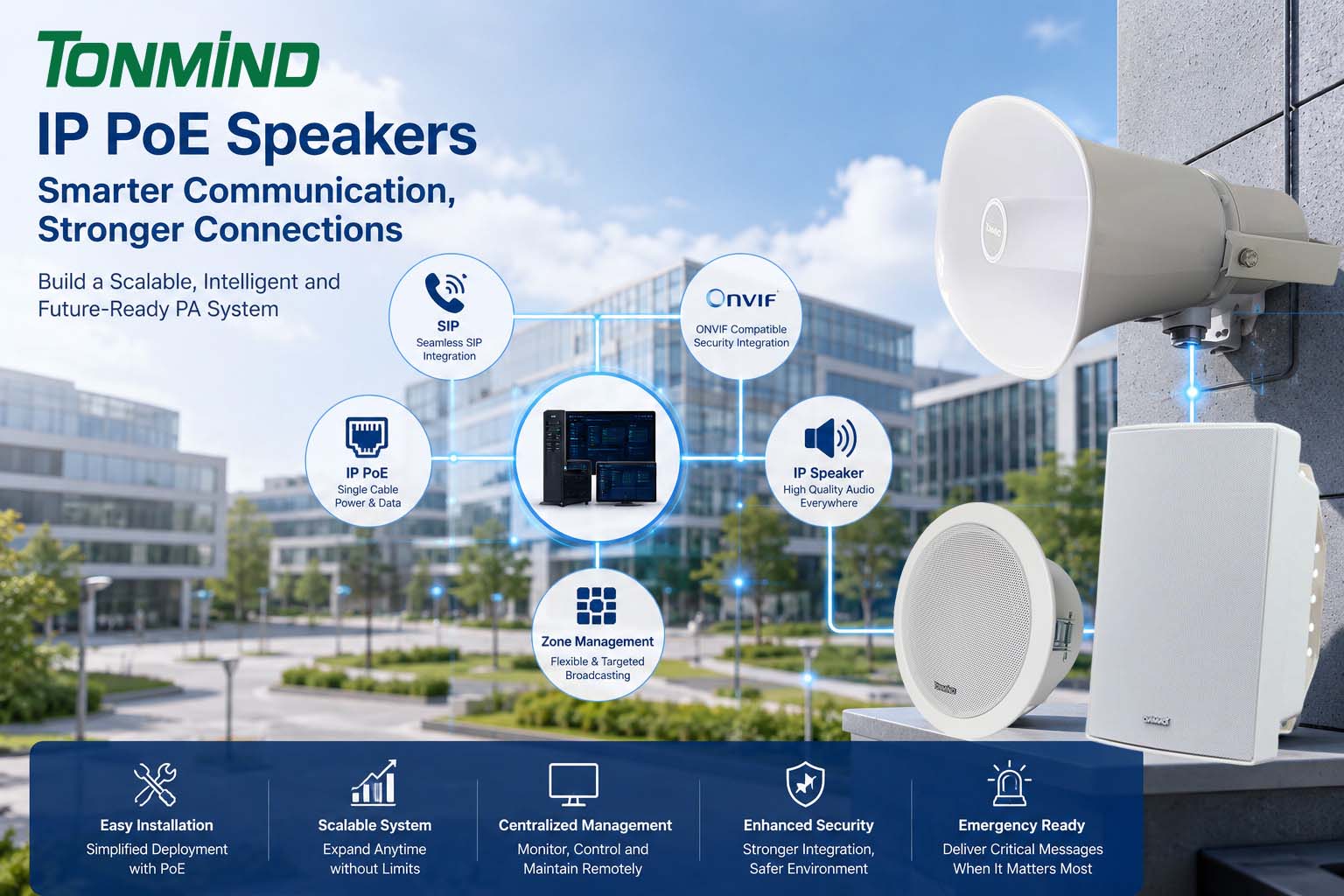
Une communication claire joue un rôle important dans les installations modernes, qu'il s'agisse de campus scolaires, de pôles de transport, de bâtiments commerciaux, d'usines de fabrication ou de centres de santé. Alors que la technologie réseau continue d'évoluer, de nombreuses organisations étudient les solutions audio basées sur IP comme alternative aux systèmes analogiques traditionnels, recherchant une plus grande flexibilité, une gestion simplifiée et de meilleures capacités d'intégration.
Parmi ces solutions, les haut-parleurs IP PoE ont suscité un intérêt croissant pour Système de sonorisation IP et les applications de communication audio. En combinant la transmission audio, l'alimentation électrique et la connectivité réseau via un seul câble Ethernet, ils peuvent contribuer à simplifier le déploiement tout en offrant des fonctionnalités qui peuvent être plus difficiles à obtenir avec des systèmes de haut-parleurs conventionnels. S'appuyant sur l'expérience du secteur et sur le travail continu de TONMIND dans la communication audio IP, cet article présente certains des principaux avantages et considérations pratiques des haut-parleurs IP PoE dans les systèmes de sonorisation modernes.
Les systèmes de sonorisation traditionnels reposent souvent sur des alimentations séparées, des amplificateurs centralisés et un câblage étendu des haut-parleurs, ce qui peut rendre l'installation et les extensions futures plus complexes.
Les haut-parleurs IP PoE utilisent une infrastructure réseau standard et la technologie Power over Ethernet (PoE), permettant de transmettre l'audio, l'alimentation et la connectivité réseau via un seul câble Ethernet. Chaque haut-parleur fonctionne comme un point terminal connecté au réseau, contribuant à simplifier le déploiement et la gestion.
Cette architecture offre plusieurs avantages :
● Installation simplifiée avec moins de câbles
● Déploiement flexible sur les réseaux LAN existants
● Contrôle indépendant des haut-parleurs individuels ou des zones
● Extension plus facile du système sans recâblage majeur
● Capacités de surveillance et de gestion à distance
● Intégration avec d'autres systèmes basés sur le réseau
Pour les organisations qui planifient une infrastructure de communication à long terme, les systèmes audio basés sur IP peuvent offrir une plus grande flexibilité et évolutivité par rapport aux approches analogiques traditionnelles.
À mesure que les besoins en communication évoluent, de nombreuses organisations recherchent des systèmes audio qui prennent en charge non seulement les annonces courantes, mais aussi la communication d'urgence, l'intégration de la sécurité et la gestion centralisée.
Comparées aux systèmes traditionnels, les solutions de haut-parleurs IP peuvent offrir une plus grande flexibilité. Les haut-parleurs réseau peuvent recevoir des annonces en direct, des messages programmés, de la musique d'ambiance, des alertes d'urgence et des diffusions déclenchées par des événements depuis une plateforme centralisée. Cela permet de gérer plus efficacement la communication sur plusieurs sites via le réseau.
Pour les déploiements de grande envergure, la gestion centralisée peut contribuer à simplifier les opérations quotidiennes. Les administrateurs peuvent configurer les zones audio, surveiller l'état des appareils, effectuer des mises à jour à distance et gérer la distribution du contenu sans devoir se rendre auprès de chaque haut-parleur individuellement.
Diffusion flexible basée sur les zones
Une fonctionnalité couramment adoptée des systèmes audio IP est la diffusion par zones.
Plutôt que d'envoyer le même message à toutes les zones, les organisations peuvent créer différentes zones audio selon les exigences opérationnelles. Par exemple :
● Les écoles peuvent envoyer des annonces à des bâtiments sélectionnés.
● Les usines peuvent diffuser des mises à jour de production dans des ateliers individuels.
● Les hôpitaux peuvent distribuer des informations aux services désignés.
● Les installations commerciales peuvent diffuser différentes musiques d'ambiance dans différentes zones.
Cette approche peut contribuer à améliorer l'efficacité de la communication tout en réduisant les perturbations inutiles. Avec Audio IP Logiciel, les systèmes de haut-parleurs IP PoE peuvent gérer un grand nombre d'appareils tout en maintenant un contrôle flexible sur les zones individuelles.
De nombreuses entreprises modernes utilisent déjà des systèmes téléphoniques VoIP pour les communications internes. L'intégration des fonctionnalités de sonorisation dans ces environnements crée des avantages opérationnels significatifs.
Les haut-parleurs réseau TONMIND prennent en charge SIP protocoles, permettant une interopérabilité directe avec les systèmes IP-PBX et VoIP compatibles. Les utilisateurs autorisés peuvent lancer des annonces en direct depuis des téléphones SIP, des consoles de diffusion ou des logiciels de communication sans nécessiter de matériel de diffusion dédié.
La sécurité devient de plus en plus une exigence essentielle pour les installations modernes. Les systèmes de communication audio jouent désormais un rôle important dans le soutien des stratégies de surveillance et d'intervention d'urgence.
De nombreuses solutions audio IP avancées prennent en charge l'intégration avec les systèmes de gestion vidéo grâce à des normes telles que ONVIF. En connectant les appareils audio aux plateformes de surveillance, les opérateurs peuvent combiner la surveillance vidéo en temps réel et la diffusion audio dans un seul environnement de gestion.
Les applications pratiques comprennent :
● Intervention vocale en direct lors d'incidents de sécurité
● Avertissements audio déclenchés par des événements de surveillance
● Instructions d'évacuation d'urgence
● Communication à distance avec des emplacements spécifiques
● Réponse coordonnée aux incidents audio-vidéo
Lorsque les systèmes audio et vidéo fonctionnent ensemble, les équipes de sécurité bénéficient d'une meilleure connaissance de la situation et de capacités de réponse plus rapides.
La diffusion d'urgence est une fonction importante de nombreux systèmes de sonorisation.
Les haut-parleurs IP PoE peuvent être intégrés aux systèmes d'alarme incendie et aux plateformes de gestion des urgences afin de fournir des instructions d'évacuation, des alertes de sécurité et des notifications d'urgence lorsque des événements prédéfinis se produisent. En dirigeant les annonces vers des zones spécifiques, les organisations peuvent fournir une communication plus ciblée là où elle est nécessaire.
Pour les campus, les installations de transport, les hôpitaux, les sites industriels et les lieux publics, ces capacités peuvent contribuer à soutenir la communication d'urgence et à améliorer la coordination des interventions lors de situations critiques.
TONMIND se concentre sur le développement de solutions pratiques et flexibles de communication audio IP pour une variété d'applications. Son portefeuille de produits comprend :
● SIP adaptateur de radiomessagerie
● radiomessagerie IP Microphone
● IP logiciel audio
● Interphone IP
Tous les produits suivent les normes industrielles ouvertes courantes, avec des conceptions de déploiement flexibles, aidant les clients à construire des systèmes audio capables de s'adapter aux futurs besoins commerciaux tout en permettant une utilisation quotidienne simple.
Nos produits audio en réseau peuvent être utilisés dans les écoles, les immeubles de bureaux, les hôpitaux, les usines, les pôles de transport et les projets de villes intelligentes, permettant aux utilisateurs de réaliser une communication efficace et une gestion centralisée du système.
La migration des systèmes audio analogiques vers une infrastructure de communication basée sur IP se poursuit dans divers secteurs. Les entreprises et les institutions recherchent de plus en plus des solutions audio économiques et faciles à gérer, adaptées aux environnements réseau existants et capables de s'adapter aux changements opérationnels quotidiens.
Les haut-parleurs IP PoE peuvent répondre efficacement à ces besoins courants. Grâce à la transmission réseau, à l'alimentation PoE, à la gestion centralisée ainsi qu'à la compatibilité SIP et ONVIF, ils constituent une option viable pour les systèmes modernes de sonorisation et leurs mises à niveau.
Avec l'intégration continue des technologies de communication, de sécurité et de gestion des installations, les solutions audio IP resteront un choix pratique pour créer des environnements d'installations plus sûrs, plus intelligents et mieux connectés.